26/05/2026
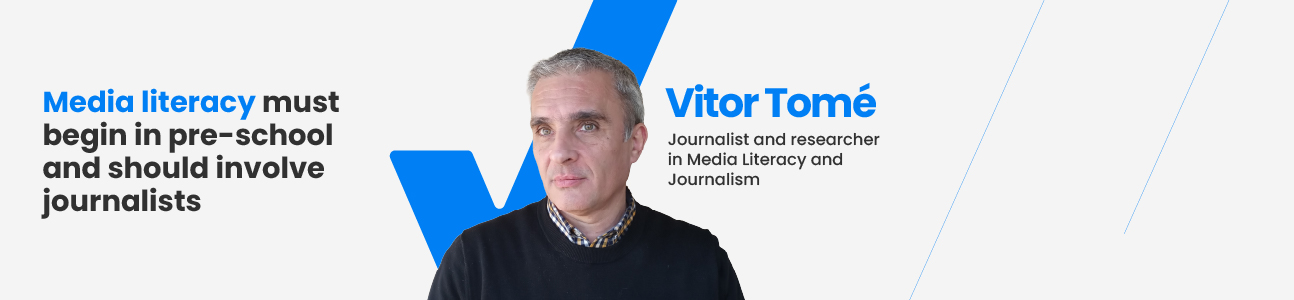
Media literacy must begin in pre-school and should involve journalists
Vitor Tomé
Autonomous University of Lisbon / Iscte – University Institute of Lisbon
Tomé, V. (2026). Media literacy must begin in pre-school and should involve journalists. SmartVote. https://doi.org/10.5281/zenodo.20394726
In conceptual terms, this article is grounded in Media Literacy, in its broadest sense, as the umbrella concept of all other literacies, from news literacy to AI literacy, as recognized by UNESCO. We associate it here with Education for Digital Citizenship, an umbrella concept of the Council of Europe that is anchored in the institution’s three pillars: Human Rights, Democracy, and the Rule of Law.
Media Literacy is the “set of competencies that enables an individual to access the media and its contents, to understand and critically evaluate those contents (conveyed in different languages) and the contexts in which those media operate, as well as to create, in a reflective way, messages in various contexts, to disseminate those messages through different channels, in order to intervene socially and bring about change” (Tomé, 2025, forthcoming).
Education for Digital Citizenship consists of positive and competent engagement with technologies (to create, work, share, socialize, investigate, play, communicate and learn), active and responsible participation (values, skills, attitudes, knowledge and critical understanding) in communities (local, national, global), at all levels (political, economic, social, cultural and intercultural), and a lifelong learning process (in formal and informal contexts); upholding Human Rights and human dignity (Frau-Meigs, O’Neill, Soriani and Tomé, 2017).
Media Literacy is a key condition for the exercise of participatory and responsible citizenship, which must be learned from birth and throughout life. In terms of formal education, it should begin in pre-school, in line with Education for Digital Citizenship, involving the whole community, with particular emphasis on the roles that journalists can assume in the process.
Foundations
Pre-school education is fundamental in critical areas of development, such as reading and writing, linguistic, motor and cognitive skills, including problem-solving ability and decision-making. It is also fundamental in terms of social and emotional development and critical thinking, since the ability to evaluate information critically not only emerges but also develops in early childhood, constituting a pillar of critical reasoning.
An empirical study involving 120 children aged 3 to 7 concluded that, even at pre-school age, children evaluate as more acceptable factual statements that are based on verified evidence, as opposed to those that have not been sufficiently verified. It also revealed that the level of this ability is correlated with the explicit understanding that children demonstrate regarding the criteria underlying the acceptance or rejection of information (Butler, Schmidt, Tavassolie and Gibbs, 2018).
Research also shows that early participation in Media Literacy activities can increase resilience against disinformation and extremist messages, thereby fostering support for democratic principles (Lauricella, Herdzina and Robb, 2020).
Media literacy in pre-school education helps prepare children to understand and interact with the media and its messages (Rek, 2019; Vrabec, Polievková & Moravčíková, 2013), by analyzing, questioning and reflecting on those contents, which informs their social participation (Novitskyi, Taranenko, Kalenych, Baranova and Poberezhets, 2025; Suárez-Perdomo, Garcés-Delgado and Arvelo-Rosales, 2025).
It goes beyond the technical dimension of access to the media, and beyond the approach to risks and opportunities, as it is grounded in critical thinking, dialogue, reflection and continuous self-reflection, whether regarding languages, representations, the actors involved in content production, or the ways of reaching and engaging audiences (Buckingham, 2019). It should be associated with philosophy, promoting reflection on knowledge and information, an attitude of questioning, and ethical reasoning (De Schrijver and Cornelissen, 2023; D’Olimpio, 2017).
Combined with critical and philosophical thinking, Media Literacy prepares children for active, participatory and responsible citizenship (Shykyrynska, Liapunova, Melnykova, Mnyshenko & Petryshyna, 2025), particularly in contexts that value community, a sense of belonging and inclusion, that is, contexts that are conducive to learning citizenship and democratic values (DeZutter, S. L., 2023; Zachrisen, 2016).
Challenges
Developing Media Literacy in pre-school education involves responding to a set of challenges. To begin with, research in this field has historically been more focused on children aged nine and above (Holloway, Green and Livingstone, 2013), and only in the last ten years has this situation changed, with projects such as the COST Action The digital literacy and multimodal practices of young children (DigiLitEY)1, which brought together, between 2015 and 2019, researchers from 38 countries and from various scientific fields.
From this action, we highlight two identified needs: i) for educators to integrate digital tools into pedagogical activities in a way that is coherent with the context and aligned with principles defined by the school; ii) for policymakers to invest in initial and continuous training for educators, as well as in appropriate technological resources and in funding further research (DigilitEY, 2018).
The fact is that the integration of Media Literacy into initial teacher training is still in its early stages in many European countries (Mesquita, Pranaityte-Wergin and Castellini da Silva, 2023) and has progressed only in a fragmented way in continuous teacher training, which has been more focused on functional skills than on cultural ones, the latter being associated with critical thinking (Buckingham, 2022).
Although Media Literacy exists in some curricula, its implementation is fragmented and does not follow a universal process. Therefore, it is necessary to research and structure ways of including media literacy in the pre-school curriculum, in order to consistently promote democratic values (Rek, 2019).
Another challenge concerns the training of journalists. Although, at the end of 2020, they accepted the challenge set out in the “European Democracy Action Plan”1, which highlighted the need to “support the involvement of journalists in Media Literacy activities, particularly through initiatives in schools”2, it is important to analyze the work they have carried out.
In an analysis of seven Media Literacy projects involving journalists, currently underway across four continents, Tomé (2025) concluded that the target audiences are teachers, students, journalists and other members of the community, but none clearly targets pre-school teachers or students. The same applies to the resources made available, whether methodological in nature or materials to be used in training settings.
Journalists are mainly trainers of students, teachers or other journalists, but the training that these journalist-trainers have received to perform this role is not clear, except in one project in which the participating journalists were previously trained in media literacy and were also certified by the Ministry of Education to train teachers.
Conclusions and recommendations
Media Literacy, in complementarity with Education for Digital Citizenship, must begin in pre-school and should involve journalists, in line with the objectives of the SmartVote project, which focus on democratic participation and the co-creation of tools to increase resilience to disinformation, involving journalists and journalism students in this task.
It is by the end of pre-school education that children develop critical areas, including critical thinking, which enables them, among other things, to assess and identify credible and non-credible information based on explicitly learned criteria. This contributes to increasing resilience against disinformation and extremist and/or polarized messages.
The task is not easy and must be developed from birth and throughout life, which requires more research involving children up to the age of eight, as well as initial and continuous training for educators, adapted to the context and using appropriate pedagogical methods and resources, since such training is still in its early stages in many European countries and is not always focused on the critical dimension.
Curricula must also be adjusted according to real contexts, so that effective pedagogical practices grounded in meaningful educational principles can take place in practice. It is within this framework that journalists should be prepared to collaborate with teachers and educators, going beyond occasional participation in classrooms where they address journalistic practices and verification techniques.
Recommendations
In light of the above, we consider that journalists should play a central role in Media Literacy strategies at all levels of education, without excluding other non-formal or informal learning contexts. Our focus here is on pre-school education, in which journalists, with appropriate training in the field, can collaborate at seven levels:
- Creating informational content for children, balancing professional methods with the diversity of children and their contexts, so that they engage with the content in a meaningful way (Haavisto and Kyllönen, 2025).
- Collaborating in the production (or adaptation) of resources for children that can be made available online and used by teachers and educators, whether it is the tool being developed by SmartVote or others, such as those from RTP Ensina, which provides content for all levels of education in the field of media, but not yet for pre-school1.
- Explaining journalistic practices and professional standards (impartiality, sources, verification of information…), developing skills in the area of critical thinking, even with very young children (Foà, Tomé, Margato, Paisana, Crespo and Cardoso, 2023).
- Disseminating resources and guidelines for parents, or participating in sessions with these parents and caregivers, discussing how the media works and ways in which parents can address media uses and practices, risks and opportunities with children (Permpoonputtana, Doungsri, Kunwittaya, Khamnong and Kleebpung, 2024).
- Training teachers and educators, with journalists needing prior training and certification as teacher trainers, so that the training can be accredited and contribute to teachers’ career progression (Tomé, Branco, Nery and Crespo, 2023).
- Collaborating in the creation, implementation and evaluation of community-based media literacy intervention projects, which may originate in kindergartens and primary schools and involve the production of school media, such as school newspapers (print and online), a YouTube channel or others (Tomé and Abreu, 2023).
- Actively participating in national media literacy and citizenship policies, such as the national media literacy plan (e.g. Portugal), the national strategy to combat disinformation (e.g. Ireland), or in major international events such as Media Literacy Week (global).
References
Buckingham, D. (2019). Media Education Manifesto. Cambridge, UK: Polity Press.
Buckingham, D. (2022). Who needs data literacy? https://davidbuckingham.net/2022/04/20/who-needs-data-literacy/
Butler, L. P., Schmidt, M. F. H., Tavassolie, N. S., & Gibbs, H. M. (2018). Children’s evaluation of verified and unverified claims. Journal of Experimental Child Psychology, 176, 73–83. https://doi.org/10.1016/j.jecp.2018.07.007
Comissão Europeia (2023). Documents on Defence of Democracy. https://commission.europa.eu/publications/documents-defence-democracy_en?prefLang=pt
De Schrijver, J., & Cornelissen, E. (2023). Can Truth Change? Philosophical Dialogue to Foster Pupils’ Reflection About (Mis)information. In Education in the Age of Misinformation: Philosophical and Pedagogical Explorations (pp. 143–161). Springer International Publishing. https://doi.org/10.1007/978-3-031-25871-8_8
DeZutter, S. L. (2023). Children’s Classroom Citizenship Enactment: Challenges and Opportunities. Em International Perspectives on Educating for Democracy in Early Childhood: Recognizing Young Children as Citizens (pp. 329-338). Taylor and Francis. https://doi.org/10.4324/9781003229568-26
DigilitEY. (2018, August). Digital Literacy and Young Children: Towards Better Understandings of the Benefits and Challenges of Digital Technologies in Homes and Early Years Settings. Policy brief os the COST Action IS1410/ EECERA Digital Childhoods SIG. https://drive.google.com/file/d/17MhHL1YnAWryLLUumRL-qw_amJ6kpaCH/view?usp=sharing
D’Olimpio, L. (2017). Media and moral education: A philosophy of critical engagement. Taylor and Francis. https://doi.org/10.4324/9781315265452
Foà, C., Tomé, V., Margato, D., Paisana, M., Crespo, M., & Cardoso, G. (2023). Roles of journalists in media literacy initiatives: trainees and trainers. Continuity, collaboration, and sustainability of media literacy trainings to mitigate disinformation in Portugal. Profesional De La información Information Professional, 32(6). https://doi.org/10.3145/epi.2023.nov.21
Frau-Meigs, D., O’Neill, B., Soriani, A. e Tomé, V. (2017). Digital Citizenship Education: Overview and new perspectives. Strasbourg: Council of Europe. Accessed from: https://www.researchgate.net/publication/337812656_Digital_Citizenship_Education_overview_and_new_perspectives
Frau-Meigs, D. (2019). Information disorders: Risks and opportunities for digital media and information literacy? Medijske studije (Media Studies), 10(19), 10-28. https://doi.org/10.20901/ms.10.19.1
Haavisto, C., & Kyllönen, R. (2025). Who is the News-Consuming Child? How Producers of Children’s Journalism Construct their Audience. Journalism Practice. https://doi.org/10.1080/17512786.2025.2551980
Holloway, D., Green, L. and Livingstone, S. (2013). Zero to eight. Young children and their internet use. LSE, London: EU Kids Online.
Lauricella, A. R., Herdzina, J., & Robb, M. (2020). Early childhood educators’ teaching of digital citizenship competencies. Computers and Education, 158, Artigo 103989. https://doi.org/10.1016/j.compedu.2020.103989
Mesquita, L., Pranaityte-Wergin, L. & Castellini da Silva, R. (2023). D2.1 Report on findings of initial investigations. Teacher Education: providing guidance, resources and support to teacher trainers on Media Literacy in Europe. https://media-and-learning.eu/files/2024/02/D2.1-Report-on-findings-of-initial-investigations.pdf
Novitskyi, V., Taranenko, H., Kalenych, V., Baranova, O., & Poberezhets, H. (2025). Fostering Media and Information Literacy and Critical Thinking Skills in the Digital Age. International Journal on Culture, History, and Religion, 7(SI1), 193-207. https://doi.org/10.63931/ijchr.v7iSI1.161
Permpoonputtana, K., Doungsri, J., Kunwittaya, S., Khamnong, T., & Kleebpung, N. (2024). Digital Media Consumption Patterns and Development of Preschool Children: Developing a Manual to Enhance Media Literacy in Parents of Children Facing Developmental Challenges. Natural and Life Sciences Communications, 23(3), Artigo e2024043. https://doi.org/10.12982/NLSC.2024.043
Rek, M. (2019). Media education in Slovene preschools: A review of four studies [Medijska vzgoja v Slovenskih vrtcih: Pregled štirih študij]. Center for Educational Policy Studies Journal, 9(1), 45-60. https://doi.org/10.26529/cepsj.659
Suárez-Perdomo, A., Garcés-Delgado, Y., & Arvelo-Rosales, C. N. (2025). Systematic review on adolescents’ construction of media literacy in educational settings. Review of Education, 13(1), Artigo e70048. https://doi.org/10.1002/rev3.70048
Shykyrynska, O., Liapunova, V., Melnykova, O., Mnyshenko, K., & Petryshyna, T. (2025). Training of Future Specialists for the Formation of the Foundations of Media Literacy of Children of Preschool and Primary School Age. Em Environment Technology Resources – Proceedings of the 16th International Scientific and Practical Conference (Vol. 3, pp. 319–323). RTU Press. https://doi.org/10.17770/etr2025vol3.8532
Tomé, V. & de Abreu, B. (2023). Empowering Communities with Media Literacy: The Critical Role of Young Children. Peter Lang: New York.
Tomé, V., Branco, S., Nery, I. & Crespo, M. (2023). Portuguese Journalists training teachers in the new media education landscape during COVID-19. In Friesem, Y., Raman, U., Kanižaj, I., & Choi, G.Y. (Eds). The Routledge handbook on media education futures post pandemic (pp. 216.225). New York: Routledge.
Tomé, V. (2025, no prelo). Experiências internacionais em literacias e cidadania digital. In Ana Paula Lourenço e Paula Lopes (Eds.), Direitos da Criança e Comunicação Social. Lisboa: Livros Horizonte.
Vrabec, N., Polievková, P., & Moravčíková, M. (2013). The role of media literacy development as a part of religious education curriculum. European Journal of Science and Theology, 9(5), 211–223.
Zachrisen, B. (2016). The contribution of different patterns of teachers’ interactions to young children’s experiences of democratic values during play. International Journal of Early Childhood, 48(2), 179–192. https://doi.org/10.1007/s13158-016-0166-0