19/03/2026
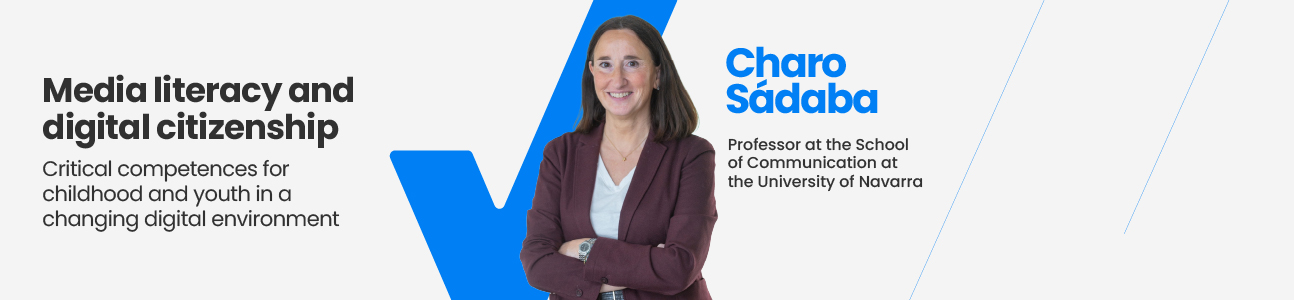
Critical competences for childhood and youth in a changing digital environment
Charo Sábada
Sádaba, C. (2026). Critical competences for childhood and youth in a changing digital environment. SmartVote. https://doi.org/10.5281/zenodo.20058838
The importance of media literacy in childhood and youth
Nowadays, watching videos, playing online, or talking with friends through social media is part of the daily routine of boys and girls. The digital environment has become a common space where time is spent on leisure, socialization and, at times, learning. Although there are warning voices about the risks that this reality may entail, the truth is that various sociocultural factors make it difficult to think of generalized alternatives. Contemporary lifestyles often limit activities or settings such as playing in the street or spending time with family, which have undeniable advantages. Moreover, the scientific evidence on the impact of digital use on children’s well-being is neither conclusive nor unanimous.
Faced with a scenario that is unavoidable, with potential dangers but also with multiple opportunities, it becomes essential to ensure that children and adolescents acquire the competences and tools necessary to understand and navigate these environments in a safe and critical way.
Beyond disinformation: a competence for life
Media literacy is often associated with the fight against disinformation and with the ability to detect hoaxes or fake news. However, its scope is much broader: it contributes to the development of skills as relevant as making well-grounded arguments, expressing oneself respectfully in digital environments, or recognizing the influence that certain content exerts on decisions and behaviours.
Within the framework of the Year of Digital Citizenship, these competences take on particular importance. Media literacy is consolidated as a pillar for the education of responsible, critical and participatory citizens in digital environments. In a context marked by accelerated digitalization and the emergence of artificial intelligence, this capacity—understood as the ability to access, analyze, evaluate and create messages—becomes increasingly essential. Educating also for civic participation is an opportunity offered by technology and requires an active and critical approach that can only be entrusted to education.
Although it is necessary to continue advancing in the incorporation of media literacy into the education system, the importance of the family and of society as a whole in the acquisition and consolidation of this competence cannot be denied. The work of fathers and mothers, through their guidance and advice, and the responsibility of public actors to provide positive models and behaviours are essential. Sadly, we are witnessing a political reality in which it is not easy to find moderation and respect in the discourse of representatives, something that is clearly reflected on social media and generates polarized and radicalized views, fertile ground for the proliferation of hate speech.
Recommendations and regulatory frameworks
Among the more than 100 proposals included in the Report of the Committee of Experts for the development of a safe digital environment for youth and children (2024), measure number 7 pointed to the need to “strengthen the elements of the educational curriculum that promote life skills, support the well-being and health of children and adolescents, and respond to social concerns that affect them: safe digital environments, media and information literacy, affective-sexual education, and health education.” Although much of the media attention focused on restrictive or prohibitive measures related to technology, the inclusion of media literacy in the report is fundamental. This measure also connects with the recommendations of international bodies such as the European Commission, which for years has promoted active policies in this field (Sádaba&Salaverría, 2023).
The presence of media literacy in Spanish legislation is not new. Organic Law 1/1996 on the Legal Protection of Minors, amended in 2015, already incorporated it as an essential tool to help minors develop critical thinking, act responsibly online, and identify technological risks. More recently, Law 13/2022 of 7 July, the General Law on Audiovisual Communication, in its Article 10 establishes the obligation for both public administrations and audiovisual service providers to adopt measures to promote media literacy across all social groups, ages, and types of media. It also requires the periodic evaluation of the progress achieved. In this latter case, the instruments that would allow for the effective monitoring and enforcement of the law have not yet been developed, which is necessary in order to assess its effectiveness.
In the case of the education system, media literacy has at times been limited to optional subjects and, at best, identified as a cross-cutting competence associated with digital competence. Some European initiatives propose considering the possibility of giving it a more visible presence in the educational curriculum, although the complexity of its implementation in a decentralized system, with seventeen regional authorities responsible, is evident.
A vaccine against disinformation
Media literacy thus emerges as a key tool for guaranteeing fundamental rights of children: the right to be informed, to participate in public life, and to do so safely. By promoting critical skills that allow individuals to distinguish facts from opinions, identify disinformation, analyze information rigorously, and produce responsible content, it becomes what we could consider a genuine vaccine against the pandemic of lies and hoaxes.
One might think that children are protected from this disinformation pandemic precisely because of their apparent lack of interest in political or social current affairs, where much of the battle of lies and hoaxes takes place. However, in the content they consume—particularly that created by content creators or influencers—it is very important to ensure that they possess the critical thinking needed to analyze and evaluate the messages they receive. At times, behind a layer of entertainment, challenges or trends are proposed that can even endanger the physical integrity of children (Feijoo et al., 2024). There are also commercial contents that, under an apparently organic appearance, generate attitudes and consumption preferences that may not be entirely free. And, of course, there is the ability to judge exposure to images or lifestyles that convey normative or unattainable models and that may generate personal frustration(Vizcaíno Verdú et al., 2024).
Preparing for a constantly changing future
The digital ecosystem is changing at great speed. Today the focus is on social media, but also on artificial intelligence and virtual worlds. Media literacy not only prepares children to face the challenges of the present, but also equips them to navigate future scenarios that we cannot yet foresee.
The key lies in understanding that media literacy is not just another school subject, but a vital competence that runs through personal, social, and civic life. Just as people learn to read and write in order to access knowledge, it is necessary to learn how to interpret, analyze, and produce messages in a digital environment saturated with information. Only in this way can children be active protagonists rather than mere passive spectators of the digital culture they inhabit.
Moreover, investing in media literacy is investing in social cohesion and democracy. Citizens capable of identifying biases, questioning simplistic narratives, and participating in debates in a respectful and well-founded manner constitute an antidote to polarization and hate speech. Far from being an educational luxury, media literacy is an urgent necessity for sustaining more inclusive, participatory, and just societies.
Finally, we must not forget that technological change will be permanent, but the critical compass that media literacy provides remains. Educating children and adolescents with these tools means ensuring them a future in which they can move with freedom, responsibility, and autonomy, without becoming trapped by the logics of manipulation or by dynamics that reduce their capacity to make decisions. Ultimately, it means guaranteeing that they can exercise their digital citizenship in a full and conscious way.
Digital citizenship is not limited to access to technology; it also involves the ability to participate actively in online communities, defend one’s own rights, respect those of others, and contribute constructively to digital society. Media literacy is the foundation that enables this citizenship to be exercised with judgement, responsibility, and respect.
In this way, investing in media literacy is also investing in strong digital citizenship: one that combines technical competences, critical thinking, and ethical commitment, and that ensures that younger generations become active agents in building a more just and democratic digital ecosystem.
References
Feijoo, Beatriz, Sádaba, Charo and Segarra-Saavedra, Jesús. «Viral challenges as a digital entertainment phenomenon among children. Perceptions, motivations and critical skills of minors» Communications, vol. 49, no. 4, 2024, pp. 578-599. https://doi.org/10.1515/commun-2022-0044
Sádaba, Charo, & Salaverría, Ramón (2023). Combatir la desinformación con alfabetización mediática: análisis de las tendencias en la Unión Europea. Revista Latina De Comunicación Social, (81), 1–17. https://doi.org/10.4185/RLCS-2023-1552 Vizcaíno-Verdú, A., Feijoo, B., & Sádaba, C. (2025). Behind the Adolescent Filter: Unveiling the Connection Between Digital Body Image Edition, Satisfaction and Well-Being. Atlantic Journal of Communication, 33(4), 597–610. https://doi.org/10.1080/15456870.2025.2470737
Comité de Personas Expertas (2024), Informe del comité de personas expertas para el desarrollo de un entorno digital seguro para la juventud y la infancia, Ministerio de Juventud e Infancia. Madrid. Accesible en: https://www.juventudeinfancia.gob.es/es/comunicacion/notas-prensa/comite-expertos-juventud-e-infancia-propone-107-medidas-crear-entornos.
Charo Sádaba is a Full Professor at the School of Communication at the University of Navarra. Over the last twenty years, her research has focused on the relationship between children and adolescents and digital technologies, and she has participated in various research projects in countries across Latin America, Europe, and Spain. More recently, she has oriented her work toward the digital and media competences of younger populations. In 2022 she was a member of the European Commission’s Expert Group on tackling disinformation and promoting digital literacy through education and training. In 2024 she was part of the Committee of Experts organized by the Government of Spain that produced the Report for the development of a safe digital environment for youth and children. She is part of the Iberifier+ team, the Iberian hub of the European Digital Media Observatory.