05/05/2026
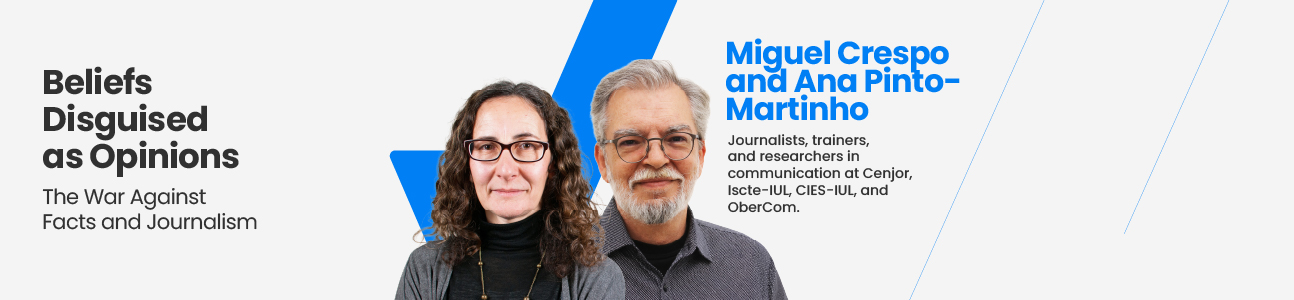
Beliefs Disguised as Opinions: The War Against Facts and Journalism
Miguel Crespo and Ana Pinto-Martinho
Crespo, M., & Pinto-Martinho, A. (2026). Beliefs Disguised as Opinions: The War Against Facts and Journalism. SmartVote. https://doi.org/10.5281/zenodo.20057887
Journalism was shaped throughout the 20th century as a mediator between reality and the public, thanks to its ability to inform, contextualize, and build critical bridges between events (facts), the public sphere, and citizens, fostering democratic debate and the understanding of society.
The emergence of the internet as an unmediated space, the development of blogs, and later social media, have democratized not only access to information but also its production and dissemination, making it accessible to everyone. In doing so, journalism has lost its near-exclusive role in portraying reality to citizens in democratic societies (Sixto-García et al., 2024; Fischer, 2023; Schrape, 2021).
The challenge facing journalism —competing with non-journalistic information— does not diminish its importance, but it does compel media organizations and their professionals to confront new challenges, particularly how to assert the strength of facts in the face of the opinions of non-specialist citizens, and even more so against the resistance generated by beliefs when facts do not support them or even contradict them.
Denialist or revisionist movements, organized either through formal structures or more organically, have called into question the role of journalism and of facts themselves, relying on beliefs, perceptions, or pseudo-opinions with no grounding in reality.
This proliferation of erroneous, false, or manipulated information has also spread to party politics across most democracies (Lisboa et al., 2023), raising the question of how far we can go if we allow lies to become the basis for political decision-making. If beliefs, pseudo-opinions, or even the denial of facts and science are considered valid premises for the implementation of public policies, democracies will become hostage to those who are most effective at spreading falsehoods, regardless of the intentions behind them.
If one of the major challenges facing democracies today is ensuring that facts and science prevail, journalism is essential, as it acts as a mediator between events and citizens by selecting, interpreting, and presenting facts, making them understandable, credible, and relevant to the public. This mediation is not neutral; rather, it is shaped by ethical, deontological, and methodological criteria, guided by the public interest and the pursuit of objectivity, while remaining aware of the limitations and challenges inherent to human subjectivity. Journalists thus occupy a fundamental position, being responsible for mediating between different spheres —governors and the governed, the powerful and the general public— and for fostering an informed citizenry and active civic participation (Schudson, 2008).
As a mediator, journalism serves as a public forum, promoting dialogue and giving voice to social plurality, while providing context, analysis, verification, and explanation of events. It is also a function of journalism to legitimize social institutions (scientific or cultural, for example), expand citizens’ knowledge, frame and give visibility to issues that are fundamental to democracy, and contribute to the development of democratic debate and citizenship (Silva, 2024; Marinho, 2015; Carey, 2009)
We can therefore define journalism, through its role as a qualified mediator between reality and the public, as one of the pillars that sustains the functioning of democracies and their societies. The growing complexity of the information landscape in the digital age compels us to clarify how to distinguish facts, opinions, and beliefs—and why this distinction is vital for journalistic credibility.
If we consider the fact as the cornerstone of journalistic information (Sponholz, 2009), it is necessary to establish its definition within the journalistic context, understood here as a real, verifiable, and relevant event that serves as the raw material for the journalist’s work and that can be subject to observation, documentary validation, or verification. In turn, a “statement of fact” is a proposition, a descriptive assertion about reality, and represents the linguistic or communicative translation of that event. Thus, a distinction is made between the event itself (fact) and what is said or written about it (statement of fact). In practice, the fact is the event as it occurred —for example, “there was a storm in Lisbon”—, while the “statement of fact” is the account, description, or interpretation of that event —in the same example, “Lisbon was hit by a strong storm yesterday.”
In journalistic practice, objectivity and rigor require that statements of fact be verifiable according to observable reality or validated data, distinguishing them from opinions, inferences, or purely subjective interpretations (Tuchman, 1972).
Contrary to what citizens often claim, confusing facts, opinions, and beliefs, there is also room in journalistic practice for opinion, for a legitimate and well-defined interpretative perspective on facts, within what are known as opinion genres (editorials, columns, reviews, etc.). However, by bringing together facts and opinion within the same spaces and moments, the media place journalism at risk of contamination, which may occur when opinion is presented as fact or, at the very least, is not clearly identified as such.
In journalism, opinion is defined as an evaluation or value judgment on a given topic, constructed through the interpretation and analysis of facts, events, or data. Opinion is grounded in arguments, experiences, values, and knowledge, and it is essential that it clearly reveals its interpretative and therefore subjective nature to the audience (van Dijk, 1998).
Opinion in journalism should be based on verifiable facts, framed within the informational context, and clearly distinguished from objective information.
Ethical and deontological rigor requires journalists to clearly separate opinion from factual information, making explicit that it represents a subjective perspective supported by rational arguments and contextualization (Público, 2005). A major risk for journalism arises when opinion is presented or perceived as fact, leading to informational contamination that undermines journalistic credibility and confuses the public. This risk challenges the essential distinction between facts and interpretations, hindering critical thinking and promoting bias. Therefore, clarity, transparency, and integrity are required in distinguishing between what is reported as fact and what is expressed as opinion.
It can therefore be concluded that opinion in journalism must be legitimized by argumentative rigor and by a clear distinction from facts, making it crucial to avoid presenting it improperly as objective truth in order to preserve trust and the democratic function of journalism.
More common among the general public or among non-journalist commentators, the confusion between what constitutes an opinion built upon factual information and what is merely the reproduction of beliefs without verifiable foundation (Rodrigues & Aguiar, 2023) poses even greater challenges to journalism. This is because beliefs often lead those who hold them to express firm convictions and to resist evidence, even when facts prove otherwise.
It is natural and acceptable for citizens, commentators, or journalists to hold their own cultural, religious, political, or personal beliefs, and for these to influence their perception of reality. Thus, the journalistic challenge lies in being able to address beliefs without legitimizing falsehoods, denial of facts or science, or even disinformation (Lisboa & Benetti, 2015).
A belief is defined as a subjective conviction held by an individual or group about something, which may be based on experiences, traditions, emotions, or processes of socialization, and does not necessarily require empirical or rational grounding. Cultural, religious, political, sporting, or personal beliefs deeply shape the perception of reality, influencing the interpretation of events, attitudes, and decision-making.
This perceptual bias is reinforced by algorithms that prioritize polarizing content, which has contributed, among other factors, to the erosion of public trust in the media. The Digital News Report (Newman et al., 2025) indicates that fewer than half of respondents trust the news in most countries, while the consumption of hybrid sources such as podcasts and social platforms continues to grow.
In this context, the Dunning–Kruger effect becomes particularly relevant. It describes a cognitive bias whereby individuals with low levels of knowledge or competence in a given domain tend to overestimate their own abilities, while more competent individuals tend to underestimate them (Kruger & Dunning, 1999). This discrepancy arises because the same gaps in knowledge that limit performance also hinder the ability to recognize one’s own ignorance. It is therefore a phenomenon with significant implications for the field of information and public communication.
In the context of news consumption and production, the Dunning–Kruger effect manifests itself on both the side of content producers and audiences. On the one hand, there is a proliferation of sources that speak with confidence about topics they do not fully understand, whether on social media or in traditional media, such as television or radio programs focused on opinion and commentary. The disproportionate confidence with which they convey partial or incorrect interpretations can be particularly persuasive, as confidence is often mistaken for competence (Scharrer et al., 2020).
On the other hand, journalists or commentators may underestimate the complexity of certain issues, especially in highly technical fields such as science, economics, or public health. Excessive simplification, while often driven by editorial needs, contributes to the reproduction of incomplete analyses that can ultimately be misleading.
From the perspective of reception, the Dunning–Kruger effect also manifests when readers reject knowledge conveyed by specialists in favor of trusting their own intuition. Inflated confidence in individual judgment—often fueled by a superficial reading of content or exposure to simplified narratives—generates resistance to expert knowledge, along with a growing sense of hostility toward what is perceived as “intellectual.” A recent example of this occurred during the COVID-19 pandemic, when certain segments of the population dismissed scientific recommendations in favor of personal beliefs or unverified information circulated online (Pennycook & Rand, 2020).
Considering the above, the Dunning–Kruger effect can exacerbate the spread of disinformation, as it facilitates both the production and consumption of inaccurate or misleading content. By creating a vicious cycle—self-confident sources lacking substantial knowledge that find an audience among readers who trust their own intuition and distrust scientific authority—this phenomenon contributes to the erosion of public trust in experts and institutions. The combination of overconfidence among content producers and insufficient critical literacy among audiences creates an information environment particularly vulnerable to manipulation and polarization.
In summary, the Dunning–Kruger effect is not limited to being an individual bias; within the contemporary media ecosystem, it functions as a catalyst for broader social processes that sustain disinformation and weaken the quality of public debate. Recognizing the presence of this bias at different stages of communication—from content production to reception—is a fundamental step toward strengthening media literacy strategies and restoring the value of specialized knowledge.
These beliefs function as interpretative lenses, reinforcing cognitive biases and prioritizing information that aligns with or confirms prior expectations or values—thereby amplifying distortions in the perception of reality—while dismissing information that challenges those same beliefs.
Journalism faces the challenge of informing without legitimizing beliefs as if they were facts, factual data, or any form of pseudo-truth. This entails clearly distinguishing between verifiable facts and beliefs or interpretations, adopting rigorous methods of information gathering and verification, and ensuring a plurality of voices without validating disinformation, prejudice, or unfounded narratives. The imperative of journalism is to promote public understanding, safeguard its credibility, and prevent personal beliefs from becoming collective falsehoods.
This underscores the importance of distinguishing between belief (convictions), opinion (interpretations of facts), and fact (observable and verifiable knowledge) in the media and journalism, as well as the fundamental role of journalism in mediating information in a democratic society.
References:
“Livro de Estilo” (2005) Jornal Público, 2ª edição, pp45-47.
Anderson, C.W., Downie Jr., L. & Schudson, M. (2016). “The News Media: What Everyone Needs to Know.” Oxford University Press, United Kingdom.
Carey, J.W. (2009). “Communication as Culture: Essays on Media and Society.” Routledge. Routledge, New York, USA.
Fischer, R., & Jarren, O. (2023).” The platformization of the public sphere and its challenge to democracy”. Philosophy & Social Criticism, 50(1), 200-215. https://doi.org/10.1177/01914537231203535
Kruger, J., & Dunning, D. (1999). “Unskilled and unaware of it: How difficulties in recognizing one’s own incompetence lead to inflated self-assessments”. Journal of Personality and Social Psychology, 77(6), 1121–1134. https://doi.org/10.1037/0022-3514.77.6.1121
Lewandowsky, S., Ecker, U.K.H., Cook, J., van der Linden, S., Roozenbeek, J. & Oreskes, N. (2023). Misinformation and the epistemic integrity of democracy, Current Opinion in Psychology, Volume 54. https://doi.org/10.1016/j.copsyc.2023.101711
Lisboa, S., Benetti, M. (2015) “O jornalismo como crença verdadeira justificada.” Brazilian Journalism Research, v.11, n.2. https://doi.org/10.25200/BJR.v11n2.2015.664
Marinho, S. (2015). “Jornalismo e Formação em Mudança: modelos e construções na análise do caso português.” Braga: CECS, Universidade do Minho, Portugal. ISBN: 978-989-8600-32-5.
Newman, N., Ross Arguedas, A., Robertson, C. T., Nielsen, R. K., & Fletcher, R. (2025). “Digital News Report 2025”. Reuters Institute for the Study of Journalism
Pennycook, G., & Rand, D. G. (2020). “Fighting misinformation on social media using crowdsourced judgments of news source quality. Proceedings of the National Academy of Sciences”. 117(1), 277–283. https://doi.org/10.1073/pnas.1912444117
Rodrigues, C. M. & Aguiar, L.A. (2023) “Jornalismo como forma de conhecimento e o imperativo da verdade.” Cuadernos de Educación Y Desarrollo – QUALIS A4, 15(3), 2459–2476. DOI: https://doi.org/10.55905/cuadv15n3-023
Scharrer, L., Rupieper, Y., Stadtler, M., & Bromme, R. (2020). “When science becomes too easy: Science popularization inclines laypeople to underrate their dependence on experts. Public Understanding of Science” 29(4), 400–418. https://doi.org/10.1177/0963662520904455
Schrape, Jan-Felix (2021). : Platformization, pluralization, synthetization: Public communication in the digital age, SOI Discussion Paper, No. 2021-02, Universität Stuttgart, Institut für Sozialwissenschaften, Abteilung für Organisations- und Innovationssoziologie, Stuttgart. https://www.econstor.eu/bitstream/10419/240194/1/1767988095.pdf
Síxto, M. (2008). “Why Democracies Need an Unlovable Press.” Cambridge, United Kingdom: Polity Press.
Silva, M.T. (2024). “Fundamentos e Inquietações do Jornalismo.” Coleção ICNOVA, Lisboa, Portugal. DOI: https://doi.org/10.34619/wjpr-nphb
Sixto-García, J., Duarte-Melo, A. & Andrade, J.G. (2024). “The relationship between the most consumed digital media in Portugal and audience participation mechanisms”. Front. Commun. 9:1466140. https://10.3389/fcomm.2024.1466140
Sponholz, L. (2009) “O que é mesmo um fato? Conceitos e suas consequências para o jornalismo.” Revista Galáxia, São Paulo, n. 18, p. 56-69. https://revistas.pucsp.br/index.php/galaxia/article/view/2642/1683
Tuchman, G. (1972) “Objectivity as Strategic Ritual: An Examination of Newsmen’s Notions of Objectivity.” American Journal of Sociology, vol.7, n.4. DOI: https://doi.org/10.1086/225193
van Dijk, T.A. (1998). “Opinions and ideologies in the press.” In: Bell, A. & Garrett, P. (Eds.). Approaches to Media Discourse, Oxford: Blackwell, pp. 2163.