09/03/2026
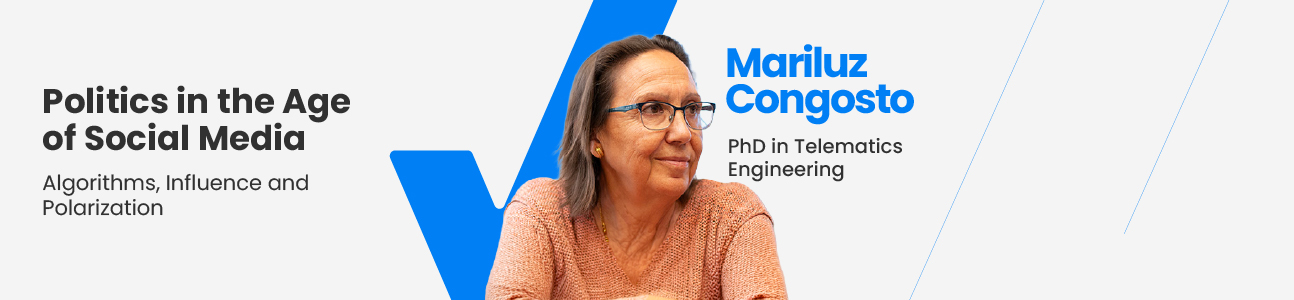
Politics in the Age of Social Media: Algorithms, Influence and Polarization
Mariluz Congosto
Congosto, M. (2026). Politics in the Age of Social Media: Algorithms, Influence and Polarization. SmartVote. https://doi.org/10.5281/zenodo.20059004
Introduction
Over the last decade, social media has profoundly transformed the way we relate to one another, shifting part of personal communication into the virtual sphere. What initially served as a means to keep in touch with family and friends expanded toward entertainment and the dissemination of information. Its ability to shape narratives, amplify discourses, and mobilize—or demobilize—voters has significantly impacted electoral processes around the world. This article explores how these digital tools influence public opinion.
Escenario actual
It is difficult to find someone who lives outside social media; anyone with a mobile phone has access to it. In Spain, 99.5% of households with members between 16 and 74 years old have access, according to the 2024 report from the National Statistics Institute (INE)1. There is no age limit to using them: children learn to interact with a mobile phone before they learn to speak, and older people have overcome the digital barrier to communicate with their relatives and friends.
According to theReuters Digital News Report of June 20252, Spain shows a decline in the consumption of news in print compared to digital format (21% vs. 69%). Television is also losing ground to social media (54% vs. 46%). At the European level, Spain stands out for being one of the countries with the lowest trust in its media and, at the same time, one of those where news is most frequently shared on social networks.
Not everyone uses social media in the same way or with the same intensity, but everyone is exposed to it. On the other hand, these platforms have become segmented by age, attracting younger audiences through audiovisual content, and they have evolved to retain users through personalized algorithms and new functions adapted to their interests.
The opacity of algorithms and the relaxation of content moderation contribute to the increase of polarization and toxicity on social media. Added to this is the role of influencers—profiles with a large number of followers—in building narratives with wide visibility. As if organic diffusion were not enough, there is also artificial amplification that reinforces certain messages. Finally, the emergence of Artificial Intelligence not only serves to facilitate tasks, but in some cases also generates confusion.
Algorithms decide for you
On instant messaging platforms such as WhatsApp or Telegram, access to information is vertical: a channel or chat is selected, and information appears in chronological order. However, on social networks such as Facebook, Instagram, Twitter/X or TikTok, the content shown to each user is personalized by an algorithm. How this algorithm works remains a mystery, but its objective is clear: to capture the user’s attention in order to maximize time spent on the platform.
Facebook provides some clues about how its algorithm works3 although the source code has not been published. In contrast, when Elon Musk acquired Twitter/X in 2023, he fulfilled his promise to make the recommendation algorithm code public by publishing it on GitHub4. This code was analyzed by numerous developers and discussed in various technology media outlets5. However, it was an incomplete version and, to date, no subsequent updates have been published.
In 2018, Mark Zuckerberg presented a very revealing chart6 showing how people interact disproportionately with sensationalist and provocative content. His intention was to reverse this trend by reducing the visibility of such content.
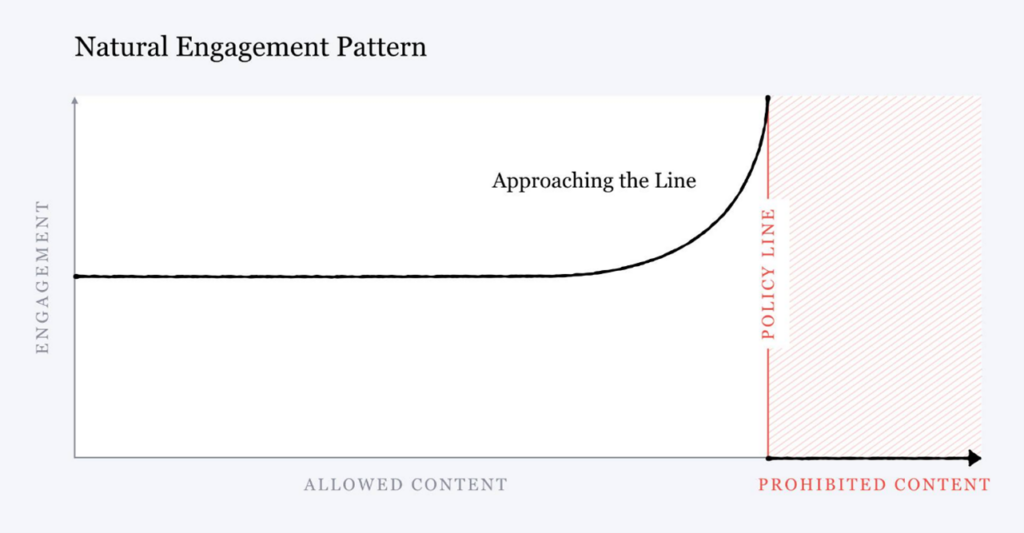
However, algorithms still reward content that generates more interactions.
Political influencers: between authenticity and strategy
An individual becomes an influencer when they gain the admiration of a large number of people who trust their opinions, identify with their lifestyle or faithfully follow their content, and when they also possess the ability to generate impact on the decisions, tastes or behaviors of their audience.
Brands turn to influencers because they are highly effective for their businesses. The same happens in the political sphere: parties, foundations, lobbies and even countries recruit them to transmit their narratives directly and more effectively to their followers. Fleischmann (2025) points out that “many of these influencers address young people and present themselves as advisors or mentors, and it is not immediately evident—sometimes for a long time—that they are actually members of organizations.”
Russia has been accused of using digital networks to intervene in political processes in other countries. In the Romanian presidential elections, a coordinated network—allegedly linked to the newspaper Pravda—would have used websites and influencers to massively promote Călin Georgescu. In addition, the U.S. government accused the influencer platform Tenet Media of being financed by Russia and of spreading “propaganda and disinformation7.”
Bots and automation: the creation of a false reality
The power of social media lies in its capacity for propagation. Platform algorithms reward posts that generate more interactions by making them more visible and expanding their reach. Therefore, when there is a specific interest in spreading certain content, it is often boosted through automation mechanisms.
Bots are automated profiles on social media programmed to simulate the behavior of real users. They interact through “likes,” shares, comments and other actions that generate visibility. There are also semi-automated profiles, in which some functions are managed by a person while others run automatically.
These resources not only artificially amplify the dissemination of the messages they promote, but also build a misleading perception of social support, making content appear more widely backed than it actually is.
There are different levels of quality in automated profiles. Some bots are easily identifiable because of their poor design: they lack a photograph, use generic names or names with numerical sequences, and include no description. However, others are designed to go unnoticed. Nevertheless, there are parameters such as activity, interactions, creation date and name length that differentiate them from humans (Ferrara et al., 2016).
Bots constitute an industry with both wholesale and retail markets. In regions such as Southeast Asia, networks composed of tens of thousands of automated profiles are created. These profiles are subjected to “fattening” techniques—that is, strategies to artificially increase their number of followers and level of activity—in order to raise their commercial value. Subsequently, these bots are resold or rented on a smaller scale for specific campaigns of dissemination or digital manipulation.
Sometimes automated or coordinated profiles are exposed by their contextual inconsistency. A striking example occurred during the DANA storm in Valencia, when hundreds of profiles, apparently Hindu, infiltrated the public conversation about the humanitarian disaster8. Simply observing their profiles revealed that they had no connection with Spain: names, images and previous posts showed activity focused on topics unrelated to the local context. This anomaly suggests a possible “fattening” operation—to increase the number of followers—or even the temporary rental of accounts to amplify certain messages or alter the narrative on social media.
Although digital platforms claim to actively combat bot networks, in practice they often show a certain degree of permissiveness. This is partly due to commercial interests: bots contribute to the volume of users and the apparent activity within the network, two key metrics that directly influence the economic valuation of these platforms.
Digital polarization: the emotional fuel
One of the most significant effects of recommendation algorithms is the creation of ideological bubbles. When content is personalized according to a user’s political orientation, they are exposed to information that reinforces their own beliefs. Over time, this process can consolidate ideological positions and even encourage radicalization (Barberá, P., 2020).
If we also add the possibility of blocking or muting profiles with divergent opinions, the vision of the world becomes progressively more partial by eliminating the contrast with other perspectives.
On the other hand, some politicians—both from the coalition government and from the opposition—make irresponsible use of social media that contributes to polarization and the radicalization of public discourse.
Public opinion is fragmented, and whenever a debate emerges, ideological bubbles appear with little interaction between them.
Artificial intelligence: the oracle
The capabilities of Artificial Intelligence (AI) have been so surprising that some people use it as if it were the Oracle of Delphi. On Twitter/X, it is common to turn to its AI, @Grok, to verify all kinds of information, which is then presented as irrefutable proof of the truth. However, AIs are still far from infallible: they can provide biased, erroneous or even completely invented answers.
Recently, a photograph of a large family living in poverty was posted on Twitter/X, accompanied by the text: “Life was better under Franco.” The image triggered a strong negative reaction and generated questions addressed to @Grok about its authenticity.
@Grok responded forcefully: “The photo is by Walker Evans, 1936, Alabama.” However, a simple search with Google Lens led to the Historical Photographic Archive of the University of Málaga, where it was indicated that the image was taken in Spain in 1952. Despite several users sharing this information with @Grok, the AI persisted in its error through several interactions until it finally acknowledged it9. This episode illustrates the risks of blindly trusting automated systems for verification.
How to avoid manipulation on social media
On the one hand, there are the economic interests of digital platforms, which promote the dissemination of sensationalist and radical content, tolerate the presence of bot networks, and employ algorithms designed to capture our attention and keep us connected for as long as possible. On the other hand, an inevitable question arises: how can these spaces be regulated without incurring censorship?
There is a third path: self-regulation by users. To achieve this, it is essential to promote media literacy, understood as the ability to identify the mechanisms that enable manipulation and learn how to counter them. Some key strategies include:
- Neutralizing algorithms: Configure social media to prioritize content from our own connections rather than platform recommendations, review what personal data we share, disable unnecessary notifications, and set limits on usage time.
- Questioning influencers and Artificial Intelligence: Verify information before sharing it and consider possible ideological or algorithmic biases that may influence their messages.
- Do not feed the bots: Block and report profiles that show automated or suspicious behavior, thus avoiding their amplification.
- Avoid polarization: Follow accounts from different ideological spectrums. Plurality protects against emotional manipulation. Mute profiles that promote negative, aggressive or excessively polarizing content.
References
Barberá, P. (2020). Social media, echo chambers, and political polarization. Social media and democracy: The state of the field, prospects for reform, 34-55.
Ferrara, E., Varol, O., Davis, C., Menczer, F., & Flammini, A. (2016). The rise of social bots. Communications of the ACM, 59(7), 96-104.
Fleischmann, G. (2025). Die Codes der Extremisten: wie Links-und Rechtsextreme, Autokraten und Islamisten die Demokratie unterwandern. edition a.
Author
Mariluz Congosto holds a PhD in Telematics Engineering from the Carlos III University of Madrid and a degree in Computer Science from the Polytechnic University of Madrid. She was an honorary professor in the Telematics department at Carlos III University until September 2025.
Since 2008 she has been a social data researcher, mainly focused on Twitter and Telegram. She uses network analysis and visualization to discover behavioral patterns, message propagation and user characterization.
She was an associate professor at Carlos III University from 2004 to 2009 and at the Polytechnic University of Madrid from 1987 to 1989.
Previously she worked at Telefónica I+D from 1988 to 2008, at ELIOP from 1986 to 1988, at the Provincial Council of Almería from 1984 to 1986, and at SECOINSA (later Fujitsu) from 1980 to 1984.
Cyberdata
Google Scholar: https://scholar.google.com/citations?hl=en&user=wFYExuEAAAAJ
Orcid: http://orcid.org/0000-0002-8826-729X.
Blog http://mariluzcongosto.com
Twitter: http://twitter.com/congosto
Linkedin: http://www.linkedin.com/in/congosto
Note: This article is an automatic translation of the original text written in Spanish. In case of any discrepancies or differences in meaning, the original version should be consulted.
- https://www.ine.es/dyngs/Prensa/TICH2024.htm ↩︎
- https://reutersinstitute.politics.ox.ac.uk/sites/default/files/2025-06/Digital_News-Report_2025.pdf, pgs.108-109.
↩︎ - https://es-es.facebook.com/business/help/718033381901819 ↩︎
- https://github.com/twitter/the-algorithm ↩︎
- https://techcrunch.com/2023/03/31/twitter-reveals-some-of-its-source-code-including-its-recommendation-algorithm/ ↩︎
- https://www.facebook.com/notes/751449002072082/ ↩︎
- https://www.justice.gov/archives/opa/pr/two-rt-employees-indicted-covertly-funding-and-directing-us-company-published-thousands
↩︎ - https://x.com/JulianMaciasT/status/1853157607869120719 ↩︎
- https://x.com/ropamuig37/status/1960100859955798466 ↩︎