19/11/2026
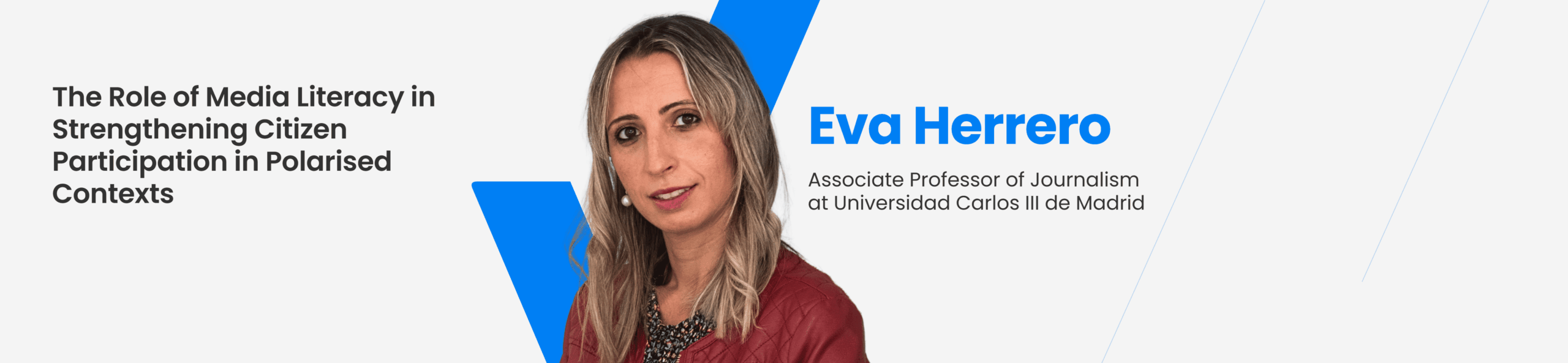
The Role of Media Literacy in Strengthening Citizen Participation in Polarised Contexts
Eva Herrero
Today, in line with McLuhan’s theories, technology acts as a direct extension of our own identity, embedding us in a digital ecosystem where content is massive and uninterrupted. In this environment, access to information stands as a cornerstone for decision-making and for participation in public, political and social life. Information has always been linked to participation through everyday actions, from voting for a particular political party, getting a medical check-up or being vaccinated, to changing route because of road incidents or roadworks. In other words, to take part in society we need to be informed, and more specifically, “well informed”.
The problem arises when this flow of information is distorted, inaccurate or has been manipulated. In these circumstances, social engagement is completely undermined. Instead of collectively guiding us towards better outcomes, it becomes something that constrains citizens and distorts public opinion.
Online social networks emerged with the promise of limitless participation: a space where each and every one of us could take part freely and on equal terms. However, the reality of today’s social networks and digital forums is a far cry from this democratic purpose. According to the Reuters Institute, active user participation on social media is disappearing and being replaced by passive content consumption, the well-known practice of scrolling (Egan et al., 2026). Interaction in the digital environment is deeply affected by polarisation. “In the digital noise of the same, we have stopped perceiving the voice of the other” (Han, 2022, p. 82). Debate frequently degenerates into offensive, sexist or xenophobic comments that feed hate speech and prioritise conflict over the pursuit of collective wellbeing or the public interest.
Interest in news has fallen from 59% in 2021 to below 46% in 2026 (Egan et al., 2026). As the Reuters report points out, this figure has direct democratic implications, since it makes it harder for citizens to engage in political processes. The group of “casual or passive” users, with little interest in current affairs, has grown from 16% to 25% over the last five years. All of this suggests a structural loss of credibility in institutions and the media.
For its part, the study ¿Cuánto cuesta una mentira? Desinformación y juventud en España [How Much Does a Lie Cost? Disinformation and Youth in Spain] (Evercom, FAD Juventud and UCM, 2025) finds that young people in Spain are showing signs of what has been termed “civic fatigue” or “democratic fatigue”. This disaffection is reflected in the fact that between 41.9% and 46.7% of young people have never voted despite being of legal voting age, and 75.4% do not belong to any social group or association. Furthermore, almost half (48.3%) admit to a lack of motivation to follow current affairs, a disconnection made worse by disinformation, which 14% perceive as a direct factor in civic disengagement.
These figures are a matter of concern and a call to action. Europe, which has been warning since 2018 about the various dangers posed by disinformation, attaches great importance to citizen participation. Today it seems clear that such participation must necessarily involve media and digital literacy. The higher our level of competence in this field, the more resources we will have to protect democratic values in a virtual environment that can no longer be separated from analogue reality.
The Spanish Charter of Digital Rights, published in July 2021, refers to the right to participate in and shape the public sphere. This right is difficult to achieve unless measures and initiatives have first been put in place to develop media competence, which is key to the critical thinking and attitude that lead citizens to make more conscious and autonomous decisions.
The European Declaration on Digital Rights and Principles (European Parliament et al., 2023) states that full participation in the digital public space requires:
- Ensuring access to a trustworthy and diverse digital environment that contributes to pluralistic public debate.
- Fostering people’s engagement and democratic participation through better use of digital technologies.
- Ensuring that very large online platforms support public discourse and mitigate risks such as disinformation, which can undermine democracy.
Nevertheless, while these goals, which depend largely on platform regulation and political will, are still being pursued, it is essential to keep promoting media literacy and the critical spirit that goes with it. Citizens must be equipped to successfully face the media and technological challenges of everyday life, and this process should begin with the youngest. This training should be lifelong and integrated across the different stages of education. Media literacy is a living field and must evolve alongside a phenomenon as complex as disinformation, which is increasingly sophisticated and has powerful allies such as artificial intelligence.
In Spain, the Informe del comité de personas expertas para el desarrollo de un entorno digital seguro para la juventud y la infancia [Report of the Expert Committee for the Development of a Safe Digital Environment for Children and Young People] (Ministry of Youth and Children, 2025) proposes measures focused on training and education, notably the design of the National Strategic Plan for Media and Information Literacy (MIL). This initiative, part of the National Digital Skills Plan, seeks to foster critical capacity that enables people to clearly distinguish between facts, opinions and hoaxes. It is an ambitious goal, but an essential one for building an engaged citizenry capable of strengthening democracy and improving social wellbeing.
References
Egan, J., Robertson, C. T., Ross Arguedas, A., Newman, N., Nielsen, R. K., Mukherjee, M., & Fletcher, R. (2026). Digital News Report 2026. Reuters Institute for the Study of Journalism. https://doi.org/10.60625/RISJ-4VGF-S811
Han, B.-C. (with Ciria, A.). (2022). La expulsión de lo distinto: Percepción y comunicación en la sociedad actual [The expulsion of the other: Perception and communication in today’s society] (2nd ed.). Herder.
Ministerio de Juventud e Infancia [Ministry of Youth and Children] (Ed.). (2025). Informe del comité de personas expertas para el desarrollo de un entorno digital seguro para la juventud y la infancia [Report of the Expert Committee for the Development of a Safe Digital Environment for Children and Young People].
Ministerio de Asuntos Económicos y Transformación Digital [Ministry of Economic Affairs and Digital Transformation]. (2021). Carta de Derechos Digitales [Charter of Digital Rights]. Government of Spain. Link
European Parliament, Council of the European Union & European Commission. (2023). European Declaration on Digital Rights and Principles for the Digital Decade. Official Journal of the European Union, C 23/1.