19/10/2026
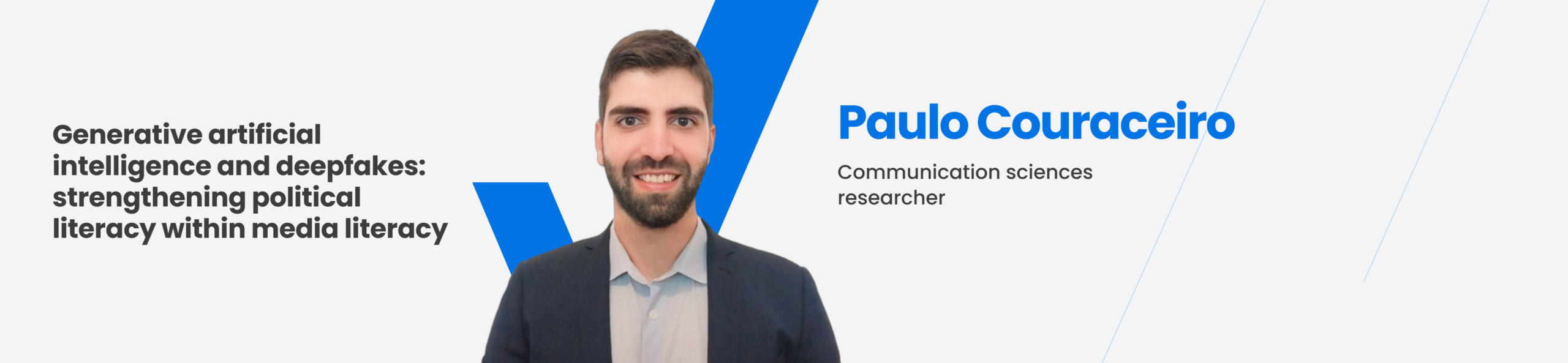
Generative artificial intelligence and deepfakes: strengthening political literacy within media literacy
Artificial intelligence (AI), particularly in its generative form, is transforming the media ecosystem structurally. It accelerates existing dynamics of digital virality and introduces new layers of opacity into the processes of information production, civic participation and democratic deliberation.
Media literacy has been understood as the critical ability to access, analyse, use and produce information. This definition, consolidated by international bodies such as UNESCO, remains fundamental. However, it must be strengthened to meet the challenges of a digital communication ecosystem marked by the centrality of algorithms and by the growing presence of content partly or wholly generated by AI. In this context, the circulation of information is often driven by the logics of virality and engagement, at the expense of knowledge and source validation.
These transformations have direct implications for political communication. They allow political actors to use digital platforms as privileged channels for disseminating their messages, bypassing journalistic scrutiny and the democratic rebuttal of their opponents. Media literacy makes it possible to understand the interests, ideologies and power relations underlying these political messages, and to assess the role of the media in the public sphere and in democracy. It is therefore increasingly important to link media literacy with political literacy, understood as the body of knowledge about the political process that enables active citizenship (Denver & Hands, 1990).
Since the emergence of social media, several scholars (Bucher, 2018; Gillespie, 2018) have shown that algorithmic systems have come to play a central role in mediating the public sphere and shaping political opinion. On social media, algorithmic systems promote the content that generates the most attention and reactions. As a result, they favour certain frames or political actors and rebalance the visibility of public discourse in favour of those who prioritise emotional appeals or the populist “us vs. them” dichotomy (Gerbaudo, 2018).
The latest generative AI models, like recommendation and content personalisation algorithms, are not neutral. They are designed with specific objectives, embed social values and operate according to optimisation logics that favour certain topics and formats. In doing so, they reproduce biases of gender, class, culture or ideology, which are particularly noticeable in images (Messingschlager & Appel, 2026; Thomas & Thomson, 2025). Furthermore, generative models such as ChatGPT have political biases of their own (Motoki et al., 2024).
The proliferation of generative AI tools enables anyone to create realistic and sophisticated synthetic content with few resources. It is therefore becoming ever harder to know who the author of a piece of content is, what their intentions are and through what mechanisms it reaches the public sphere.
Against this backdrop, the current challenge for journalists, young people and students is not merely to identify disinformation in a post that has gone viral. Rather, it requires understanding how the information ecosystem itself is organised through algorithmic systems capable of amplifying certain narratives and simulating consensus without direct human intervention. The concept of “algorithmic public opinion” describes precisely how opinions come to be constructed through citizens’ interaction with algorithmic systems, whether those of social media (Gandini et al., 2026) or those of generative AI (Kant, 2026).
Disinformation has always exploited emotions such as fear, outrage or a sense of belonging. What generative AI changes is the scale, speed and realism of disinformation. The automated production of plausible texts, images, audio and video, including deepfakes, makes disinformation cheaper, faster and harder to detect. Empirical research shows that most people cannot reliably identify deepfakes (Köbis et al., 2021; Frank et al., 2024), even when the deepfakes are labelled as fake (Clark & Lewandowsky, 2026).
In the face of the spread of deepfakes, Nadia Naffi (2025) argues that AI literacy must go beyond the mere technical detection of “fakeness” and incorporate epistemological reflection on truth and knowledge. The automated production of plausible synthetic content challenges fundamental assumptions of communication and undermines authenticity and trust. Media literacy should therefore be understood broadly. It should include the ability to understand the world and exercise critical citizenship in an information environment mediated by algorithmic systems, where seeing and hearing are no longer sufficient guarantees of truth.
When images, voices and speeches can be generated or manipulated with a high degree of realism, we create an environment of structural uncertainty in which doubt can be exploited as a political strategy. To answer the question “is this AI?”, it is therefore not enough to check the source, date, author or context. It is also necessary to understand the capabilities and limitations of generative AI and to recognise possible political or economic motives that may be disguised as satire, humour or entertainment. This means that the central question is no longer simply whether a piece of content is true or false, but above all what kind of reality that content is trying to construct.
There is a growing movement to make the origin of AI-generated content visible through labels or disclaimers. Even so, the increasing presence of bots, automated accounts and synthetic interactions raises doubts about who is actually taking part in public debate. Likes, comments and online trends may reflect not only genuine human activity but also campaigns of coordinated inauthentic behaviour. One example is astroturfing, in which an impression of support for a product, policy or idea is artificially generated that far exceeds the support that actually exists (Chan, 2024). This ambiguity makes reading public opinion more complex and calls into question whether digital metrics represent popular support or rejection.
These dynamics are compounded by the strengthening of parasocial relationships. Horton and Wohl (1956) introduced this concept to describe the illusory, one-sided relationships that audience members form with influential figures or fictional characters on radio, television or film. In contemporary digital politics, these illusory relationships of closeness, familiarity or intimacy are intensified by influencers, affective language, algorithmic personalisation and, increasingly, by chatbots and digital avatars. Studies show that such parasocial relationships can affect people’s intention to share disinformation on social media (Mulcahy et al., 2024). This underlines the importance of fact-checking and critical comments exposing falsehoods appearing as quickly as possible.
Strengthening political literacy within media literacy thus emerges as a necessary response to new forms of mediation of the public sphere. We need to understand how images, speeches and digital interactions are politically oriented, how consensus can be artificially simulated and how uncertainty can be strategically exploited. This requires skills that bring together media analysis, an understanding of political processes and critical reflection on technological power. Political literacy does not replace media literacy, but it makes its civic and democratic dimension explicit.
Strengthening political literacy within media literacy therefore means equipping citizens, journalists and students to critically interpret a hybrid public sphere in which humans and machines co-produce informational reality. More than distinguishing between true and false, it is about understanding what political realities are being constructed, by whom and with what effects, in an information environment shaped by automation, algorithmic personalisation and the erosion of traditional markers of authenticity.
References
Bucher, T. (2018). If … then: Algorithmic power and politics. Oxford University Press. https://doi.org/10.1093/oso/9780190493028.001.0001
Chan, J. (2024). Online astroturfing: A problem beyond disinformation. Philosophy & Social Criticism, 50(3), 507–528. https://doi.org/10.1177/01914537221108467
Clark, S., & Lewandowsky, S. (2026). The continued influence of AI-generated deepfake videos despite transparency warnings. Communications Psychology, 4(1), 13. https://doi.org/10.1038/s44271-025-00381-9
Denver, D., & Hands, G. (1990). Does studying politics make a difference? The political knowledge, attitudes and perceptions of school students. British Journal of Political Science, 20(2), 263–279. https://doi.org/10.1017/S0007123400005809
Frank, J., Herbert, F., Ricker, J., Schönherr, L., Eisenhofer, T., Fischer, A., Dürmuth, M., & Holz, T. (2024). A representative study on human detection of artificially generated media across countries. In 2024 IEEE Symposium on Security and Privacy (SP) (pp. 55–73). https://doi.org/10.1109/SP54263.2024.00159
Gandini, A., Keeling, S., & Reviglio, U. (2026). Conceptualising the ‘algorithmic public opinion’: Public opinion formation in the digital age. Dialogues on Digital Society, 2(1), 46–61. https://doi.org/10.1177/29768640251323147
Gerbaudo, P. (2018). Social media and populism: An elective affinity? Media, Culture & Society, 40(5), 745–753. https://doi.org/10.1177/0163443718772192
Gillespie, T. (2018). Custodians of the internet: Platforms, content moderation, and the hidden decisions that shape social media. Yale University Press.
Horton, D., & Wohl, R. R. (1956). Mass communication and para-social interaction: Observations on intimacy at a distance. Psychiatry, 19(3), 215–229. https://doi.org/10.1080/00332747.1956.11023049
Kant, T. (2026). Algorithmic public opinion in the age of generative AI. Dialogues on Digital Society, 2(1), 62–66. https://doi.org/10.1177/29768640251377160
Köbis, N. C., Doležalová, B., & Soraperra, I. (2021). Fooled twice: People cannot detect deepfakes but think they can. iScience, 24(11), 103364. https://doi.org/10.1016/j.isci.2021.103364
Messingschlager, T. V., & Appel, M. (2026). Algorithmic bias in image-generating artificial intelligence: Prevalence and user perceptions. Information, Communication & Society, 29(5), 1656–1678. https://doi.org/10.1080/1369118X.2025.2584146
Motoki, F., Pinho Neto, V., & Rodrigues, V. (2024). More human than human: Measuring ChatGPT political bias. Public Choice, 198(1), 3–23. https://doi.org/10.1007/s11127-023-01097-2
Mulcahy, R., Barnes, R., Scheepers, R., Kay, S., & List, E. (2024). Going viral: Sharing of misinformation by social media influencers. Australasian Marketing Journal, 33. https://doi.org/10.1177/14413582241273987
Naffi, N. (2025, October 27). Deepfakes and the crisis of knowing. UNESCO. https://www.unesco.org/en/articles/deepfakes-and-crisis-knowing
Thomas, R. J., & Thomson, T. J. (2025). What does a journalist look like? Visualizing journalistic roles through AI. Digital Journalism, 13(4), 631–653. https://doi.org/10.1080/21670811.2023.2229883