15/09/2026
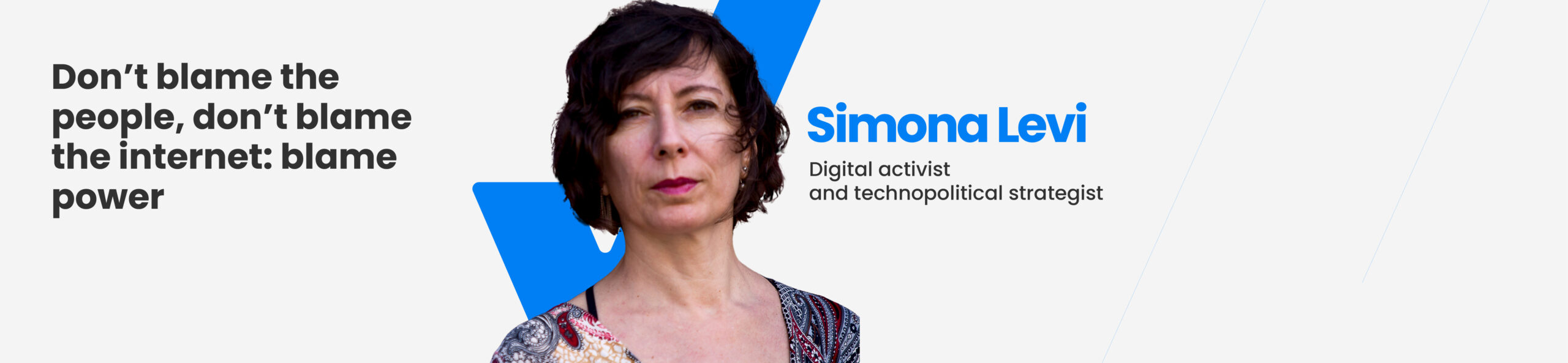
Don’t blame the people, don’t blame the internet: blame power
The battle against disinformation is not fought by informing the public, but by dismantling the political, media, and technological power structures that produce, amplify, and turn lies into profit.
By Simona Levi
Each time a disinformation crisis breaks out, the public debate is organized around a scenario as repetitive as it is misleading: a vulnerable public, overwhelming technologies, and institutions supposedly called upon to protect us from confusion. In such a scenario, the solution seems obvious: more automated moderation, more centralized verification, more tools capable of distinguishing what is true from what is false, and, if possible, an ethical artificial intelligence designed to guide us. The problem with this framework, however, is that it stems from a false premise. Disinformation is, above all else, neither an issue of individual ignorance nor a technological mishap. It is a political problem, or, more precisely, a problem of power.
I maintained this in #FakeYou and it remains, from my perspective, the crucial starting point. Not for nothing was the subtitle of my book: “Fake News and Disinformation – Governments, political parties, mass media, corporations, large fortunes: monopolies of information manipulation and the curtailment of freedom of expression.”
We must not blame the people. Nor should we blame the internet as if it were, by its very nature, a machine of democratic degradation. We must look upward, tracing the money invested and the institutional orders given to make certain messages go viral over others. That is the only path forward.
The organized lie is not born from a people’s supposed incapacity to discern truth, but from economic and political ecosystems that make deception viral, pervasive, and, above all, profitable economically and/or politically. Let us suppose that for a lie to spread efficiently, and thus change public debate, it must be injected with capital or backed by institutional orders so as to be heard above the noise. This is not characteristic of the internet, but is rather the fundamental mechanic of plain old propaganda.
That is why it worries me deeply that the dominant response to disinformation is formulated in paternalistic terms. When it is declared that it is necessary to “protect” the populace from false content, often what is being proposed is to reinforce mechanisms of paternalistic oversight: experts who decide which information is fit to circulate, platforms that arbitrate the visibility of discourse, institutions that ask for trust without offering transparency. Not only is this approach insufficient; it is also dangerous. It can end up reinforcing exactly that which it says it fights: a monopoly on the truth.
To battle disinformation cannot mean to transfer more authority to the same actors who have contributed to the degradation of the information ecosystem. The big platforms are not neutral arbiters. Nor, by definition, is the government. And the traditional media, however important it may be, is not immune to special interests, biases, dependencies, or connivances. A mature democracy is not built upon guardians of the truth, but upon material conditions that allow for verification, traceability, plurality, and accountability.
This forces us to look elsewhere. Instead of debating why people believe disinformation, we should question who profits from it, what technological architectures incentivize it, what business models reward it, what institutional opacities make it possible, and what democratic weaknesses allow it to thrive. The difference is crucial. When we blame the populace, we reduce a structural issue to a moral or cognitive failure. When we blame the internet exclusively, we reduce a conflict of power to technical fatalism. In both cases, we exculpate those who design, finance, distribute, and exploit lies on an industrial scale.
My approach is clear: leave freedom of expression alone and follow the money or the institutional power. When a message goes viral because someone pays for it, there is a buyer and a seller. This is not freedom of expression but business, and businesses not only can be but must be regulated. The same applies when a message is amplified by institutional design. In both cases, there must be strict, mandatory verification standards and clear editorial accountability.
Media and digital literacy are necessary. But it would be a mistake to present them as the primary solution. No amount of critical training can, on its own, compensate for an environment systematically designed to reward polarization, extreme emotionality, algorithmic opacity, and the attention economy. Asking for the public to defend themselves against a manipulated ecosystem is akin to transferring to users the responsibility of resisting colossal structures of power. It is like asking consumers to resolve, with attentive reading, abusive contracts drafted by armies of lawyers. Education helps, of course, but it is no substitute for democratic regulation, transparency, pluralism, or the redistribution of communicative power.
The key, therefore, is not to “protect” a supposedly credulous mass, but to foster the democratic conditions necessary for informed autonomy. That implies radical transparency and clear obligations for the intermediaries of our information ecosystem, whether they be traditional media, platforms, communication companies, or institutions. We need to know how content is prioritized, what data is used to segment it, what economic or political relations condition its visibility, and what commercial logic drives recommendation and virality. Without transparency, democratic control is impossible.
Secondly, we need structural pluralism. The fight against disinformation cannot rest on an alliance between public institutions, major media outlets, and private platforms that recognize each other as the sole legitimate mediators. That only reproduces a closed, oligopolistic public sphere. Democracy demands a diversity of channels, public or common infrastructures, interoperability, decentralization, and competitive conditions that prevent a corporate monopoly on public debate. Every one of these actors must be subject to verifiable fact-checking obligations.
Thirdly, we must recognize that disinformation thrives in environments of justified distrust. Not all suspicion is irrational. Often, what we label “credulity” or “confusion” is the result of decades of institutional opacity, corruption, unfulfilled promises, media concentration, and regulatory capture. When institutions fail to hold themselves accountable, when traditional media loses credibility due to its proximity to power, and when platforms operate as black boxes, the terrain is ripe for alternative narratives, even the most absurd, to thrive. The response, therefore, is not to demand obedience, but to rebuild credibility through verifiable practices of transparency, accountability, and openness.
We must also move past another false dilemma: freedom of expression versus protection against disinformation. This is a simplistic framework that often leads to bad policy. Freedom of expression does not mean leaving the industrial mechanisms of manipulation intact, just as protection does not justify preventive censorship or mass filtering. Between these two caricatures lies a wide field of democratic action: rules against advertising opacity, limits on political microtargeting, traceability obligations for coordinated campaigns, sanctions against organized manipulation, whistleblower protections, support for independent journalism, guaranteed data access for public audits, and the development of digital infrastructure serving the public interest.
At this point, artificial intelligence warrants extra caution. Simply presenting itself as “ethical” does not automatically make it democratic. The risk is that, under the promise of neutral technical mediation, we reinforce automated systems of classification, prioritization, and surveillance whose real functioning remains outside of public scrutiny. The question is not whether AI can help detect patterns of manipulation. Of course it can. The question is who designs it, with what data, under what criteria, with what biases, under what supervision, and with what avenues for appeal. If the answer is opaque, centralized, and proprietary, the remedy will be worse than the disease.
Therefore, the defense of rights must be central to any democratic strategy against disinformation. Although crucial, privacy is not the only right at stake; there is so much more. It means the right to comprehend the infrastructures that condition our public life, the right not to be manipulated through opaque designs, the right to know why we see what we see, the right to access services and information without being subjected to predatory data extraction, and the right to democratically governed infrastructure.
The people do not need paternalistic education; they need power. Power to understand, to verify, to organize, to audit institutions, to challenge automated decisions, to demand technological openness, and to participate in shaping the rules. Democracy is not strengthened by reducing the population to the role of vulnerable users who must be educated and protected from above. It is strengthened by recognizing them as capable political subjects, provided the material conditions to be so actually exist.
Therein lies, in my view, the central question. Disinformation is not fought by civilizing the internet or by correcting a population supposedly led astray. It is fought by dismantling structures of unaccountable power. It is fought by demanding transparency and verifiability. It is fought by guaranteeing real pluralism. It is fought with institutions that are held accountable and do not demand blind faith. And it is fought, above all, by ceasing to treat the people as the problem and starting to treat them as the solution.
If we truly want to reinforce democracy, we must abandon the moralistic and technocratic framework that dominates this debate. It is not about magically separating truth from lies with better tools. It is about deciding who governs the infrastructures of communication, with what limits, and under what social control. That is the real political terrain. And that is where the battle must be fought.
Bibliography (APA 7.ª edition)
Levi, S. (2019). #FakeYou: Fake News y Desinformación – Gobiernos, partidos
políticos, mass media, corporaciones, grandes fortunas: monopolios de la
manipulación informativa y recortes de la libertad de expresión. Rayo Verde.
Levi, S. (2024). Digitalización democrática. Soberanía digital para las personas. Rayo Verde.
Zuboff, S. (2019). The age of surveillance capitalism: The fight for a human future at
the new frontier of power. Profile Books.